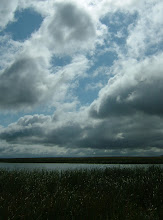
Sometimes I enjoy driving long distances because it is like a field trip with no theme. Instead of touring the cheese factory to observe cool new things and learn about cheese and the dairy industry or touring the tractor plant to get an inside look at an assembly line and electromagnets and welding and things related, you get a long rambling peek at thousands of interesting but unrelated things, leading to a trippy discombobulated mindset after a few hours.
There are the other vehicles and their wacky duct taped mirrors and garbage bag replacement windows. And the odd things other cars are hauling like three different kinds of barbecue grills on a trailer. And the weird things you can see through their windows like a office chair upside down in the backseat.
There are the things being hauled on trucks like giant machines with 'wide load' signs whose purpose you cannot discern and huge rolls of plastic tubing and many many nested truck bodies and layers of crushed cars and different sizes and shapes of lumber neatly shrink wrapped on pallets and wind tower blades that look elegant compared to the other riff raff on wheels.
There is the terrain. And the ecosystems. Flatter than flat land with no natural nature whatsoeveratall of Illinois give way rather abruptly to evergreens on steep hills in Wisconsin, followed by deciduous trees on rolling hills then fewer and fewer trees and flatter and flatter hills in Minnesota to hardly any trees at all that are not in straight lines in South Dakota.
And the fields. Corn. Corn. Oh, look more corn. Oh, soy beans. More corn. More corn. More corn. Ah, some baled straw, was that wheat? Between corn and corn? More corn. Again corn. Still corn. Corn as far as the eye can see. A pasture with cattle. Corn. Corn being chopped between corn waiting to ripen and dry to be picked much later.
And old landmarks like the rock formation and the army base at the same exit in Wisconsin and the truck-on-a-stick and the first Wall Drug sign a couple dozen miles before Sioux Falls.
And new landmarks like the cool nifty Minnesota visitor center that looks like a hybrid of an old grain elevator and a red barn and the increasing numbers of wind farms with their graceful sweeping motion and their classy white with silvery grey shadows.
And road construction zones and the variety in road construction marking devices and road construction equipment. Some of that makes you wish you could pull over and watch, but I bet that would piss off other drivers since there is often one lane each way and not much in the way of shoulder in either direction.
And the weird stuff that happens at gas station pit stops like conversations overheard about domestic fights and peoples' operations and the woman who was having a cell phone conversation from inside a bathroom stall while she went about her noisy business and I mean all versions of bathroom noisy business. Didn't ANY of those sounds carry through the phone to the other participant in the conversation? And with no hint of irony, at one point, she said "That was a really shitty thing for her to say to you. She is such an asshole."
Then there is the Groton speed trap. Really, does it do anything for the actual speeding rate to have a speed limit sign indicating a drop of 10 miles per hour at a curve? If people miss the sign because of the curve, isn't is just plain MEAN to make it a speed trap? Sure, the locals learn, but those of us 'not from around here' seem at a disadvantage. Would it not make more sense to move the sign a bit more out of town so that people see it before they begin to deal with navigating the curve and actually slow down on their own? Okay, the nice officer gave me just a 'warning' which I get to keep and use as a nifty book mark souvenir, but still. It took probably 4 minutes longer to get here because of that inconvenient stop.
All in all, I saw many interesting things and learned a few things too on my field trip with no theme today. I think I'll do it again in a week or so.
Showing posts with label Illinois. Show all posts
Showing posts with label Illinois. Show all posts
Wednesday, August 25, 2010

Tuesday, September 29, 2009


Fall It Is
The crowds were at the Morton Arboretum on Sunday hoping to catch the 'fall color' but most were probably disappointed.  It was a bit early and the only conventional signs of fall were the occasional brilliant scarlet of leaves of the Virginia creeper vines on the tree trunks. I suspect it will be a disappointing fall for leaf color,
  as the Virginia creeper that makes my garage/office into the bat cave turned reddish and dropped its leaves pretty much at the same time. There was probably not even a minute where the whole thing was red, as some were already falling off by the time others colored. This makes me expect other trees to drop their leaves soon after they color. But the determined can find signs of autumn other than the turning color of tree leaves.
  Purple and pink and white asters and yellow sneezeweed bloom in the fall. Seeds are nature's way of making sure there will be new plants after the killing freeze of winter. Seeds come in many forms, from berries to stalks of seeds at the former site of flowers to grassy seed plumes to acorns and black walnuts that were dropping from the car to plunk of car roofs. It is scary when they are landing all around you and
  missing your delicate skull by only a couple feet. We've put it off as long as we can: We finally have to admit that fall is here.
 It was a bit early and the only conventional signs of fall were the occasional brilliant scarlet of leaves of the Virginia creeper vines on the tree trunks. I suspect it will be a disappointing fall for leaf color,
  as the Virginia creeper that makes my garage/office into the bat cave turned reddish and dropped its leaves pretty much at the same time. There was probably not even a minute where the whole thing was red, as some were already falling off by the time others colored. This makes me expect other trees to drop their leaves soon after they color. But the determined can find signs of autumn other than the turning color of tree leaves.
  Purple and pink and white asters and yellow sneezeweed bloom in the fall. Seeds are nature's way of making sure there will be new plants after the killing freeze of winter. Seeds come in many forms, from berries to stalks of seeds at the former site of flowers to grassy seed plumes to acorns and black walnuts that were dropping from the car to plunk of car roofs. It is scary when they are landing all around you and
  missing your delicate skull by only a couple feet. We've put it off as long as we can: We finally have to admit that fall is here.
Friday, June 12, 2009
A Walk With The Kids
I've walked these trails in all sorts of conditions and for all sorts of reasons. I have strolled leisurely passing the time and found pleasant surprises and had lovely chats and paused to observe details of flora and fauna. I have pounded down them with a destination in sight or tramped them in anger or hiked briskly in training for some wilderness adventure.  In one way these trails irritate and aggravate me because they are often ill-maintained, infested with non-native invasive plants and crusted with disgusting litter. Yet, they present a far better place to walk than a house- and car-lined sidewalk and a far safer place to run or bike than a car- and truck-inhabited street. In various places across the country, they are shared by horseback riders or even all terrain vehicles, depending in some cases on what groups volunteer to maintain them. It took courage and foresight by those who initially lead the movements to change these old railroad beds to trails as they were abandoned by the rail companies. But now, these trails link up to each other to allow long hikes or rides for serious recreation or use by bicycling commuters. They allow for experiences in the green world that surely must lead us to a greater appreciation of and desire to protect and preserve the natural aspects of our planet. Some saw them as merely recreational trails, but they serve a deeper need for green and relative quiet, for a world that changes with the seasons and offers glimpses of the cyclic nature of nature. These trails are far greater than the sum of what any one of their founders and champions saw in them, and for that, we are all richer.
 In one way these trails irritate and aggravate me because they are often ill-maintained, infested with non-native invasive plants and crusted with disgusting litter. Yet, they present a far better place to walk than a house- and car-lined sidewalk and a far safer place to run or bike than a car- and truck-inhabited street. In various places across the country, they are shared by horseback riders or even all terrain vehicles, depending in some cases on what groups volunteer to maintain them. It took courage and foresight by those who initially lead the movements to change these old railroad beds to trails as they were abandoned by the rail companies. But now, these trails link up to each other to allow long hikes or rides for serious recreation or use by bicycling commuters. They allow for experiences in the green world that surely must lead us to a greater appreciation of and desire to protect and preserve the natural aspects of our planet. Some saw them as merely recreational trails, but they serve a deeper need for green and relative quiet, for a world that changes with the seasons and offers glimpses of the cyclic nature of nature. These trails are far greater than the sum of what any one of their founders and champions saw in them, and for that, we are all richer.
Tuesday, June 9, 2009
Wasteland
Some land is poorly drained and collects winter snow melt or allows rainwater to stand for a few days or weeks before it soaks away. Some land is low and flat and near to rivers or streams so that when the water level rises, it comes up onto the land on a fairly frequent basis. We call them floodplains, potholes, sloughs, bogs. The soil is not stable enough to support foundations or pilings. The land cannot be build on or hold a parking lot or grow a crop or even be relied upon to be safe for grazing animals.  We consider these places wastelands. Of no use to us humans. But the problem lies in our perceptions being self-centered, biased toward what direct benefit they have to us. For these are the lands of reptiles and amphibians. Frogs and toads and salamanders and all the strange insects that live part of their lives in the water that are food to these strange animals. Life for many creatures flows along smoothly, with the young getting progressively larger until mature size is reached. But reptiles and amphibians and many insect go through stages of life that are very different from each other. Frogs and toads, for example, begin life as eggs laid in places like this. They hatch out and live the first part of their lives as tadpoles, polliwogs, that 'breathe' water with gills. They more resemble fish with tiny fins and huge tails and no legs. But as they mature, they grow front legs and back legs and absorb their tail into their bodies and as their lungs develop and their gills close up, the become more and more frog- or toad-like until they can live on the land.
 We consider these places wastelands. Of no use to us humans. But the problem lies in our perceptions being self-centered, biased toward what direct benefit they have to us. For these are the lands of reptiles and amphibians. Frogs and toads and salamanders and all the strange insects that live part of their lives in the water that are food to these strange animals. Life for many creatures flows along smoothly, with the young getting progressively larger until mature size is reached. But reptiles and amphibians and many insect go through stages of life that are very different from each other. Frogs and toads, for example, begin life as eggs laid in places like this. They hatch out and live the first part of their lives as tadpoles, polliwogs, that 'breathe' water with gills. They more resemble fish with tiny fins and huge tails and no legs. But as they mature, they grow front legs and back legs and absorb their tail into their bodies and as their lungs develop and their gills close up, the become more and more frog- or toad-like until they can live on the land.
 These ephemeral spring pools and ponds are dry now, resembling green grassy meadows. A month ago, they were alive with calling amphibians who were eager to find a mate and cause this process to begin. These flat plains are still alive with life and home to the mature frogs and toads and salamanders plus countless insects and birds and animals. About a month before this, when the ice was still breaking up, eagles hunted here in the shallow water on the floodplain, catching fish who had spread out from the river bed into the spreading floodwaters. In terms of development, such places are a wasteland indeed. But in terms of life on planet earth, they are rich and beautiful ecosystems that are vital for the full functioning of our green planet.
Monday, June 8, 2009
Primrose Farm
 The Grand Opening was a week ago last Sunday. It has been a long time in the making.
  Primrose Farm is a working living history farm restored to teach about farming and farm living in the 1930's.
  It will be a good thing for the community. People need to know history.
They need to know about how agriculture shaped out land. They need to know where our food comes from.

They need to know about how people worked in earlier times. They need to know how people lived in earlier times. I worry that they will not understand this farm's place in history and therefore fail to understand what modern agriculture is like.

I worry that this farm will romanticize farming in an unrealistic way. I am happy that it might get kids outdoors. I am happy that it is open green space kept open and fairly green.

I am happy that our friend Kirk runs the place and that our friend Mary works there.
 Primrose Farm will be open to the public on Wednesdays and Saturdays and by appointment and for special events. The farm is located just south of Bolcum Road on Crane Road in St. Charles, IL.
What can you learn there? How can such a living history project help you live and make choices in the real world? What is the relevance of our history?
Friday, May 29, 2009
Damn Redbuds!

This is one of the prettiest scenes ever that I have never been able to photograph to my satisfaction. Lacking real telephoto lenses, my point and shoot gives results only as good as this. The right way to shoot it would be from a boat in the middle of the pond, which is prohibited by Arboretum rules.
Who's with me on this caper during redbud season 2010?
Monday, May 11, 2009
Along the Trail
 These trails snake across the country, in the footprints of abandoned railroad roadbeds. Railroads were a boon to the development of the nation. But the word development is a dirty word sometimes to environmentalists and railroads are not exception.
  They blasted through scenic mountains, created new towns while causing the death and abandonment of others very near by, crossed meandering rivers often blocking the oxbows and changing the course in their headlong rush to perfect efficient straightness. They damaged wetlands by impacting drainage patterns, messed with wildlife access to water and food, brought noise to previously quiet environments, and brought smoky pollution to areas with pristine clean air.
  And when the railroads got abandoned due to age or changes in needs or competition from more flexible truck shipping, no one was about to spend money to repair that damage. The stickstraight raised embankments were left there to stand as a testimony to a failed idea with lasting harmful environmental effects.
  So when a few brave souls suggested that lemonade could be make of this limitless linear lemon, it seemed radical indeed. But in the end, it was an idea that provided huge benefit at little cost. Cut out the overgrowth of weedy trees and put down some crushed gravel to make a trail on the already compacted and stable former roadbed, and you have a trail. All trails allow bikes and walkers, and some allow ATVs and some allow horses. Some trails are volunteer maintained and others are in the domain of various park districts and other municipal, county, or state natural areas management organizations. This account tells how one such set of trails started in Illinois: p://home.att.net/~naturebooks/IPP_letter.html
 My travels to Wisconsin take me along highway 20, which crosses the Jane Addams trail at a place where rest facilities are often welcome. These spring wildflowers inhabit the edges of just one tiny stretch of trail there.
Monday, May 4, 2009


Friday, May 1, 2009
Yellow Merrybells
 Merrybells. Just the name is pretty. These strange woodland wildflowers have leaves that are punctured by the stem. The stem shoots straight up then curves back down so that the flower is a yellow bell of curving twisted petals. The yellow is a subtle one, so that it blends in with the bright green of the leaves and is easily overlooked. But once your eyes catch one cluster of stems and flowers and 'learns' to see, you find them scattered along the woodland floor, each cluster its own unique arrangement of blooms and leaves. Because of that quality of being hidden then spectacularly revealed, along with the lovely grace that the flower possess, it is another of my spring woodland favorites. Merrybells: Makes me smile just to say it.


Saturday, April 25, 2009
Driving Back Home
Rolling along in afternoon traffic,
Heading home
In bright sunshine;
 Think about the people there,
 Think about the people there,
Smile about that.
Traffic jams up;
It's some idiot stalled
In the two lane construction zone
Blocking one lane,
Costing me and all these others
An extra half hour of life on this road.
Turn up the stereo until you can feel it.
Sing along, drum on the steering wheel.
Chew all the gum.
Eat all the snacks.
Fiddle with the radio.
Change the CD.
Scream at the guy when you finally pass him,
"Idiot, Moron, F#%*head, Teabag, Toadbrain!"
He can't hear you but it feels good to yell.
Moving along again
On cruise control.

Beat down the miles.
Call somebody on the cell phone.
Sun going down
Turning everything orange;
Turn on the headlights.
Turn up that song.
Eat up the miles.
Lights along the interstate
Make lines on the horizon,
Receding in perfect perspective.
Center line,
Shoulder line,
Steer in between.
Pound down the miles.
Stop for pop and to pee;
Repass all the cars you passed before.
Pick up speed
But not too much:
Don't need another ticket
Don't need another ticket
Cuz I got one goin'.
Chew up the miles,
Heading on home.
Monday, April 6, 2009
Snow Frogs
So yer whinin' about a little snow in April. So it made a mess of traffic on the way to work. So you had to scrape your windshield before you left. So nobody would go to lunch outside the building because it was to "icky" out there.  Well, I gotta tell you this: Stop your complaining. There is someone who has it a lot worse than you do.
Let's just say for a minute that you are a frog. A cold blooded animal. That means that instead of a body temperature of a level 98 degrees like us humans have, your body temperature is whatever the temperature of the air outside is, or whatever the temperature of the water you are sitting in. So over the last few days, the weather has been warm. Trees and shrubs are swelling their buds and a few have even shown layers of tiny green leaves. Nature told you with the temperature and sunlight that it is SPRING! So you pushed yourself up off the bottom of the pond where you had been hibernating in a semi-frozen state since fall and came out to start calling for a mate. Because nature also tells you that this time of year, it is time to find a girl frog by calling her to you, and then clasping onto her waist and hanging on to her as hard as you can, so that when she lays her eggs, you can release your sperm on top of them to fertilize them. That is what nature told you it is time to do: Come out of hibernation and up into the outdoors and call for a mate. And then nature sent 4 inches of wet sloppy sticky cold SNOW! But you still call. And call and call and call. In the pond edge next to the snow-covered grasses and rushes. In the snowy landscape, you call.
Now, get back to work in your warm office and no more whinin' about the snow, okay, humans?
 Well, I gotta tell you this: Stop your complaining. There is someone who has it a lot worse than you do.
Let's just say for a minute that you are a frog. A cold blooded animal. That means that instead of a body temperature of a level 98 degrees like us humans have, your body temperature is whatever the temperature of the air outside is, or whatever the temperature of the water you are sitting in. So over the last few days, the weather has been warm. Trees and shrubs are swelling their buds and a few have even shown layers of tiny green leaves. Nature told you with the temperature and sunlight that it is SPRING! So you pushed yourself up off the bottom of the pond where you had been hibernating in a semi-frozen state since fall and came out to start calling for a mate. Because nature also tells you that this time of year, it is time to find a girl frog by calling her to you, and then clasping onto her waist and hanging on to her as hard as you can, so that when she lays her eggs, you can release your sperm on top of them to fertilize them. That is what nature told you it is time to do: Come out of hibernation and up into the outdoors and call for a mate. And then nature sent 4 inches of wet sloppy sticky cold SNOW! But you still call. And call and call and call. In the pond edge next to the snow-covered grasses and rushes. In the snowy landscape, you call.
Now, get back to work in your warm office and no more whinin' about the snow, okay, humans?
Tuesday, February 17, 2009
Living Fossils
 The human brain cannot really comprehend geological time, the expanse of years since the earth has been first formed and is contiuing to be formed. The amount of time that life has been on the planet is tiny compared to the time the planet has been, and the time that life has been in forms we recognize had been a sliver of that. And of the time plants and animals have been evolving together to form ecosystems, humans have been in existance for only a tiny sliver of that. And yet that sliver of time is still a number too large for us to really comprehed. These are some of the forms of plants that are considered 'living fossils' because they are some of the earliest forms to evolve, yet they are still with us today.
  The growth pattern is from a central point much like the ferns, but lacks the fiddlehead shape of the uunfurliing fern. These plants are huge, many feet across, and beautiful in their radial structure. They can remind us of the vast amount of time that has passed that allowed wonders like these to evolve.
Monday, February 16, 2009
Fiddleheads
 Ferns might be my favorite plant unless it is summer and I am near a prairie. They are considered among the most 'primitive' of plants, yet their diversity of form and size and shape and color is awesome. All have some basic characteristics in common though.
1) They are not flowering plants: Their reproduction process begins with spores.
 They require a humid environment, due to the complex two phase reproductive process. Ferns as we know them make spores. Tiny new plants grow from spores, and this second stage plant makes eggs and sperm. The sperm requires water to swim to the egg of another tiny plant. That fertilized egg grows right there inside the tiny plant as it shrivels away, to make the fern plants that we know. This need for water on the surfaces where ferns live for the fern sperm to swim in makes Garfield Park Conservatory's fern greenhouse have the most the most humid tropical feeling of all of them.
2) Ferns have leaves that grow radially from a central stem, with most having a long lance shaped leaf. Some have strap like leaves and in others, that strap is divided or double divided into a lacey pattern. And the leaves unfurl from the central point in the shape of a curl that is called a fiddlehead, to the joy of my fiddle playing oldest son. It has been one of our traditions while in the fern room of the Garfield Park Conservatory to hunt for fiddleheads.


Wednesday, February 11, 2009
The Bridge Building Contest in Chicago

My son and his friend needed a ride to Chicago for the bridge building contest. Four entries from each high school in the surrounding area went.
The kids build bridges from kits of balsa wood supplied by the contest organizers. There were specifications regarding length of span and size and such. The bridges were then stressed by loading on weights until they failed at a contest at the high school. The four kids whose bridge load to bridge weight was highest went on to this regional event. Obviously, they had to rebuild the bridge for the regional event, as their original was destroyed, so they could apply what they learned from other bridges and from how theirs failed to make a better one. Usually that means beefing up the places your bridge failed and paring away weight from areas that held strong to make your bridge both stronger and lighter. The variety of entries was amazing, but the geometry gave them all an inherent beauty. It was fun to watch them be loaded and startling to hear them fail and just a great time to hear all those kids excited about a physics project. Smart kids can be so much fun and I had a great time talking to my son and his interesting and smart friend and to some of the other kids there. The camera is a great way to get to talk to someone about what interests them. I'd ask if I could take their picture because they were the first one to break their bridge in the contest, or because their bridge was especially pretty or some other little unique thing and they always said sure and always told me more and answered my questions. I had more fun than I thought I would and it reinforced my views that this generation of kids is pretty darn amazing.


Here is information about the contest.
http://www.iit.edu/~hsbridge/database/search.cgi/:/public/chicago/2009/announce_regional
http://www.iit.edu/~hsbridge/database/search.cgi/:/public/chicago/2009/announce_regional
Here is the page where you can click on links for the data on the bridges such as their weights and the load at which they failed.
http://www.iit.edu/~hsbridge/database/search.cgi/:/public/index
http://www.iit.edu/~hsbridge/database/search.cgi/:/public/index
Subscribe to:
Posts (Atom)