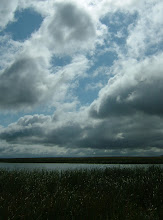
I hadn't paddled much since the Boundary Waters trip where too much wind and too high waves brought back a measure of my old fear of the water. But I resolved this week to get back to it, paddling some of the smaller lakes in the parks around Mineral Point.
It was raining this morning. I went for a paddle anyway. The light sprinkle of rain was just a little cooler than the air, making it refreshing. I put my boat into glass smooth water and paddled across the finger of lake to the far shore under the linden trees, along white barked aspen. Lime green pods of hops trees floated on the surface, hinting at stormier weather prior.
A pair of birds skirted the shore, darting from back and forth from tree to tree, so I paused a ways out, with a view of a ferny bank, and ate my lunch in a light mist. My bird watching reverie was interrupted with the sound of something crashing overhead, and I turned my boat to see a squirrel tumbling from branch to branch high in an oak tree. The return to silence after the violent interruption brought back the sounds of chirping and twittering birds. I finished my sandwich and soda and paddled on and the pair of birds flitted along just ahead of me for a while.
Huge yellow and black swallowtail butterflies drifted along between the shore and my route once the rain stopped. A patch of swamp milkweed at water's edge hosted three of them on the many dense clusters of tiny mauve flowers. Stout black dragonlies skimmed along about eye level to me.
At the end of the lake where the stream feeds it and the water is shallow, I carefully paddled though patches of floating water weed to where I could see Canada geese and mallard ducks and a great blue heron feeding. Soon, the geese took flight, right overhead, so that I could hear the whoosh of their wings with each flap.
The lack of any wind that allowed the glass smooth water also allowed for silence, except for the sound of my paddle dipping into the water and between strokes, the sound of my bow cutting across the surface. When I slowed to a near stop, I heard birds on the shore. An occasional test chirp of a cicada. A catbird mewing over and over. Crows! A low raspy caw and a higher more melodic one.
As I drifted farther into the dense mat of floating green, I heard tiny barely audible plip plops. Was the rain starting back up? No, it was bubbles rising from under water, popping when they reached the surface, the product of some mysterious underwater process. Splay legged insects hopped about the water surface and clusters of small black flies vibrated on the surface of the muck. Tiny amber damselflies landed on the gunwale of my boat and on my life jacket and once on my hand.
I watched the blue heron, standing tail feathers deep in water, as it moved its head this way and that, with long periods of waiting between movements. Finally, it struck with a darting dive of the head and a great rustling of wing feathers, then froze with a fish in its bill. After a shake of its head, it began lifting each long leg in turn, walking toward the shallows, where it finally swallowed the fish after a series of motions where it let go of the fish and darted its head forward to move the fish backwards in its long bill. Then it began looking about the water for more prey, slowly moving back toward the deeper water. But something caught its attention and it thrust its bill into the water, apparently catching smaller fish or frogs again and again. Once it let out a loud squawking and did a sideways wing flapping dance before resuming fishing in the shallows.
Soon, a bit of a breeze came up and pushed my boat sideways, plowing a wide clear swath through the floating weeds, finally pushing me aground in the muck. The heron was undisturbed by my slightly closer approach, but soon, as if on some signal, hundreds, maybe thousands, of cicadas, first on the near bank, then on the far one, began their buzzing. The heron kept its head higher after that, clearly less relaxed than it had been, and eventually with a great slow graceful flapping, took flight, winging just a few feet above the lake's surface until at the last minute, it banked sharply up to land in a skeleton of a tall tree. If I took my eye off the tree, I would lose it in the branches, until it moved again, revealing itself.
Soon it began to rain in earnest and a riffle of waves patterned the surface, so I felt compelled to head back, past the massive rock bluff and towering pines and a half dozen different kinds of ferns. Sumac were beginning to show their flower stalks, bright lime green where they will be burgundy later in the fall. Grapevines dipped into the water from overhanging tree branches.
A lull in the rain coaxed me down the other arm of the lake, where another inlet stream forms more shallows, and a brilliant display of pink Joe Pye weed was topped with dozens of dancing swallowtails, brilliant yellow in the low light of the overcast day.
I headed back in a light drizzle which seemed not to phase the ever present swallowtails, fluttering from one swamp milkweed patch to the next. The light rain held until I managed to get all my gear carted to the van and my boat tied to the top, and just as I made the left turn out of the parking lot, it began to pour.
It was a good day on the water.
Showing posts with label weather. Show all posts
Showing posts with label weather. Show all posts
Monday, August 8, 2011

Friday, June 18, 2010
How To Weather A Storm
First, you have to live on a farm. Then you have to notice that it has gotten really dark in the middle of the day or that the sky is kinda a funny color and that the tops of the trees in the shelter belt are bent over about ninety degrees. Someone should say loudly "We should probably go to the basement." Someone should root around the junk drawer for candles and matches while someone else roots around the tool drawer for flashlights and spare batteries. Someone should go to the shop to get the men and someone should go to Grandma's to get her and hold her elbow while they rush across the lawn to the house. They should stop with her to comment on the trees. Everyone should convene in the basement. Discussion should ensue as to which corner they are supposed to be in. Someone should attempt to figure it out scientifically based on which direction weather patterns generally travel and someone should counter that with how it comes from every direction at some point when the tornado spiral is passing over. There should be discussion of the strongest part of the basement structure and dangerous things like the fuel oil tank and the gas water heater. One of the men should get curious and go upstairs to take a look-see. The other men should join after he doesn't come down after a bit. One of the women should dash upstairs for the camera and go out and stand behind the men and ask if they can see anything yet. The other women should get curious and go up. This leaves the kids and Grandma, who is just as curious and powerless to stop the kids from joining the rest in the front yard. She should make one kid stay back to help her get up the steps so she can see. When everyone is in the front yard watching, if there is or has been hail, someone should find a couple of the biggest pieces to put in the freezer. After it dies down, everyone should get in the car and drive around to look for crop damage and watch the water rushing through the ditches along the highways. The final stop should be that one place where the slope of the highway is misleading and it looks like the water is flowing uphill in the ditch. Then everyone should go home and have snacks. Remember to offer that Grandma should come in for snacks too and remember to help her back home afterwards. Go check on the hail stones in the freezer in the morning.
Wednesday, April 7, 2010
Resolutions
Yes, I know: Resolutions are usually made at the beginning of the New Year, around the first of January. But as a person subject to Seasonal Affective Depression Disorder (S.A.D.D.) who is prone to deep dark moods in winter and also subject to Attention Deficit Hyperactivity Disorder (A.D.H.D.) who tends to go overboard with enthusiasm for things and then abandon them with equal fervor, January just seems like a bad time for introspection and goal setting. The introspection is apt to be overly critical and dark, due to my moodiness from lack of sunshine. And I am apt to go gung-ho off into some therefore misguided self-improvement plan then abandon it in despair and misery when it does not yield immediate and abundant results. Instead, winter for me, post-holidays, is mainly a matter of 'getting through'. Getting up and getting showered and dressed each day can be hurdle enough and seeing some people and doing some things are added bonuses. Just get by. 

The turning point for me is spring break. Having kids who, to my thinking, must be entertained in grand manner during their holiday from school forces me to focus on planning a trip and executing the steps to get us there. Once on our trip, there is time during each day of touristy touring and quiet nature appreciation to objectively think and assess and analyze and ponder what has been going on and where improvements could be made. And then, on return, when the days are longer and the weather more mild and the flowers blooming on the trees and the ground, I can make my list of what I want to do and accomplish and change and improve. The list will be made on the optimism of spring rather than the gloom of winter and I can immediately begin to put my plans in action and expect a measure of success. The list is make, the process begins. Happy New Year!
Monday, March 15, 2010
Spring Along The James
There was a pasqueflower in the pasture behind the house. We lived between the James River and Highway 1, and that my parents oriented the house toward the highway and not the river testifies to their values, which were typical of their rural farming neighbors: Access was more important than natural beauty. In fact, the 'dump' was down by the river, a pit just high enough onto the shore ridge to never be messed up by spring high water, where we dumped anything that could not be burned. It was not even buried to hide it; it was merely an open pile on the ground. And my mother was terrified of water, certain we were going to drown, so there were strict instructions to stay away from the shore. Still, I would go for long rambling walks back there, in the thigh-high grasses and short shrubby bushes. There were occasional swales where water drained from the land and had carved down a bit into the prairie, and on the near side of one of these, there was pasqueflower. I would ramble aimlessly back there day after day when I sensed it was about the right time, looking at the ground. When I found it, with its amazing fuzzy ruffled leaves and its soft purple glowing flower, I would try to count swales and judge who far back from the river bank it was, how near to the pasture fence it was, so that I could find it again the next year, or even the next week. But those judgements were never as accurate as I wished them to be, and inevitably, it would take much more searching to find it again. In that day, the way to knowledge was the World Book Encyclopedia. If it could not be found there, it remained a mystery, and since I knew it was a pasqueflower, it must have been in some entry there, maybe under flowers or prairie or spring flowers. I remember trying to memorize its features the first time I came upon it in order to look it up, then later finding a picture that was close but not exactly how it appeared in my memory. That was my first attempt to find it again, so that I could better compare the image in the book with the real plant, and be certain of its name. It gave me hope and joy to find that little promise of spring out there, just as it does today when I see the snowdrops and winter aconites along my driveway and the skunk cabbage at the local forest preserve. Yes, I has turned cold again since my muddy foray out there last week, and yes, we could even get snow again, but at least those early plants offer the promise that whatever bad weather is yet to come, it will not last. This winter WILL give way to the frothy pink days of summer then the golden yellow days of summer!
Monday, December 21, 2009
The Reason For The Season
 Axial tilt: My friend Benia brought to my attention that axial tilt is the reason for the season. Our earth revolves around the sun with a rotational axis that is akimbo to the plane of its orbit. This means that as we revolve, we have seasons. If our axis was perpendicular to our rotational plane, we would have a planet nicely layered with climates that ranged from hot at the equator to cool at the poles, a smooth gradient, and within each band, a uniform climate throughout the year. Each of our days would be exactly 12 hours of daylight and 12 hours of darkness.
  Other than changing star patterns as we went around the sun, there would be no reason to note the passing of a year, one revolution. But we sit tilted, 23.44 degrees off perpendicular, so that during part of our rotation, up here in the northern hemisphere, we tip toward the sun and as we rotate, more than half of our 24 hours are spent in light, and less than half in darkness, so that the surface can warm up for longer than it cools down, resulting in warming temperatures. During the other half of our rotation, we are tipped away from the sun, with a longer period in darkness than in light, allowing the surface to cool.
  So we owe our seasons to axial tilt. The change in temperatures happens gradually, as the energy in the atmosphere accumulates, so that the temperatures lag behind the times of daylight. So even though the change has snapped from days getting to shorter to days getting longer, we have our coldest bleakest leanest time yet to come. Yet because the change to days growing longer HAS occurred, we know that it will indeed warm up on schedule.
  And past civilizations have known these colder seasons as times of less plenty, of dwindling resources such as green plants and plant seeds to eat and less game that is out and about to hunt. And so, people have recognized that the days got shorter, then again got longer, and watched carefully to count out those turning points.
The point where the days ceased to grow shorter and began to get longer again represented a sign of hope to people that the warmer seasons were going to return again, and food and warmth would be plentiful again. And so they marked that time with a festival.
 December 21 is approximately the day on which this turn takes place, and archaeologists and anthropologists and sociologists agree that nearly all societies scheduled holidays around this time of year. Indigenous Scandinavian peoples held feast to a goddess of fertility and sanity on the winter solstice; the Greeks celebrated a feast to Bacchus. We are perhaps most familiar with the Jewish Hanukkah and the Christian Christmas, coincidentally the same day that the Romans marked winter solstice. Many cultures begin their new year on this winter solstice date and celebrate it less as a religious holiday than as the marking of the beginning of another year. Most cultures celebrate with a feast with symbolic foods, many celebrate with gifts, such as in India where sweet treats and sweet fruits were and are exchanged.
  Many of the New Year celebrations give nod to the celestial nature of the passing of one year and the beginning of the next with some sort of tradition that involves light or the sky, such as flying kites in India, fireworks in China, and candles in Scandinavia. Celts and Druids and many others build markers so that on the exact dates, the sunlight would shine in alignment with some mark. Zuni, May, and Hopi marked this winter solstice as the beginning of the new year with plant and fire rituals and feasts.
 Gifts are symbolic of our interdependence on each other and on the abundance of the seasons that are promised to us with the lengthening of days. Light and fire symbolize the sun on which the cycle and life depends. Foods and feasting celebrate the return of abundance as well as our relation to each other.
 So whatever your religion, you probably celebrate something this time of year, whether a god or goddess or saint or spirit is honored, or it is a celestial event, the passing of one year to the next. But the giving of gifts, the lighting of special lights, the preparing and sharing of special foods are all ways that we celebrate hope for the future and recognize that it is in the lengthening of the days and the return of warmer seasons that will bring us abundance, but also in our dependence upon each other and our associations with each other that we find our greatest satisfaction and joy as people. Celebrate the season of the lengthening of the days in whatever ways you wish and treasure the people around you who make your life worth living.
Thursday, December 10, 2009
State Changes
 It is just one degree. One point along the temperature gradient. One point in time as the temperature rises or falls. Above, and all water falls as rain, soaks into the ground, runs along the surface until it finds a crack or crevice or opening of some sort, and then follows the pull of gravity down into the earth. Some flows on to creeks that fill streams that fill rivers, some that soaks in seeps back out of the ground on the banks to feed the streams and creeks. It is clear and flowing, moving.
Below that point, all water falls as snow or ice pellets or sleet or some other form of solid water, and it drops, lands, and stays there. Solid, accumulating, piling up. Deeper and deeper. Unless the winds grabs and moves it to another place, still above the surface of the earth, so stop and stay somewhere else.
Raining raining raining bam snowing snowing snowing. The earth goes from dark, saturated, absorbing all water and and much of the light to BAM white, bright, resisting the snow that piles up above ground and reflects back bright light from the sky.
 One day, all is brown and tan and grey and black and the next, it is bright glistening shining white. Everything is like that, but we seldom see the change points quite so obviously. A word changes the way you think about an issue, a person. A moment, a single event, a single act, changes forever the course of a day, a life, a civilization. To see those moments and accept and adapt and adjust is a gift, a talent, a skill, and on that can hinge ones happiness or ones very survival.
Tuesday, June 23, 2009
Too Damn Hot
The 16 house guests hit the road and I settled into for a good day's work. I was gathering up the towels, upstairs and down, kitchen and bath, to start the laundry to run while I planted those shrub and trees, when the phone rang. My friend was on her way through and wanted to stop. We spent a while sitting on the deck, rocking in our chairs and talking about friends and family and events of the day. And complaining a bit how it is hot, too hot to do anything but sit, and it was nice. Made me remember taking 'lunch' to the fields on a hot July afternoon back when the farm still had some hay fields that had not yet yielded to the plow and it seemed to me there was nothing to do hotter than haying and no place on earth hotter than that hayfield. We went back home to the luxury sitting with our books in front of the humming droning fans, while the men went back to the hottest job in the hottest place. And now after an unusually cool and long spring, 'seasonable' weather is finally hot upon us and we have a new thing to gripe about, how it makes us sweat and makes the work seem twice as hard. Or, we could just sit on the deck and drink iced lemonade and plant when it cools in the evening.
Tuesday, June 16, 2009
AIR!
The screens are installed and the windows are open!
There is a fine storm brewing so the wind is blowing through the house and I can hear the rustling of the trees and it is exactly like I imagined it would be oh so very long ago when I first started designing it!
 I wanted it to be like camping, only indoors. I mean by that that I want it to have the amazing views of nature and night sky and the morning light and the evening light and the sounds of the trees and the birds and the coolness of the moving air that makes you feel like you are sleeping in the great wonderful magnificent outdoors, but that you get to sleep on a comfy mattress and use convenient . . . um, restroom facilities, and nice showers in the morning. And there is a refrigerator for cold Dew and ice and a stove and running water. The very best of camping without the nasty inconveniences! Oh, I am so happy indeed! I am camping tonight indoors!
There is a fine storm brewing so the wind is blowing through the house and I can hear the rustling of the trees and it is exactly like I imagined it would be oh so very long ago when I first started designing it!
 I wanted it to be like camping, only indoors. I mean by that that I want it to have the amazing views of nature and night sky and the morning light and the evening light and the sounds of the trees and the birds and the coolness of the moving air that makes you feel like you are sleeping in the great wonderful magnificent outdoors, but that you get to sleep on a comfy mattress and use convenient . . . um, restroom facilities, and nice showers in the morning. And there is a refrigerator for cold Dew and ice and a stove and running water. The very best of camping without the nasty inconveniences! Oh, I am so happy indeed! I am camping tonight indoors!
Saturday, June 13, 2009
Shattered Rose
 The day after the rain, the rose lies shattered against leaves and stems. Still, the sweet beautiful fragrance is there, and the pistils and stamens remain in the proximity of the separated petals, so it is possible, even likely, that bees and wasps and assorted pollinators will still find their way to this crushed beauty and others like it, and the flower's purpose will be fulfilled: A rose hip with seeds inside will develop from this apparent disaster and no evidence of any harm will be found. Too bad people are not as resilient in the face of unexpected disappointments. Or are we after all?
Thursday, June 11, 2009
The First Flower of Summer
 To me, spiderwort is the first prairie flower of summer. There are prairie flowers that bloom earlier, but when I see my first spiderwort of the season, I feel like summer has arrived. Spiderwort knows what is good for us, for she blooms only in the morning of a sunny day, soon turning her petals into an unattractive glob as the day heats up, encouraging us to take our prairie walk in the cooler morning. But on a rainy day, she keeps her flowers longer, rewarding us for venturing forth into the cool drizzle.
Sunday, June 7, 2009
Farming Sucks

The romantic myths of farming make me want to puke. Ah, the farm is so pretty, it must be great to work with the cute animals, "farmers feed the world", winters off, being outdoors all the time, no hours to keep, no office to go to. It's a job. A job like anything else has its good points and its crappy parts. Like never knowing if what you put into it will pay off at harvest time. Like being at the mercy of the weather. Like the dirt. The mud. The shit. Literally, if you raise animals. Or work outdoors where there are birds and bugs. The wind. Sunburn and dry skin and pollen that makes your head swell shut and dusty grit on your skin that turns to slimy mud when you sweat. And sore muscles from every new thing you do. It is comfortable out there about 3 days of every year and before that it is too cold and after that too hot and way too hot and even hotter and then it is okay for 3 more days but it is windy as hell and then it goes back to being too cold until next season when it starts cold again. And wet. Too wet until it is just right for that one day then too damn dry for the rest of the summer until it snows so you can't get a tractor into the fields for the goo. Pests in the form of weedy plants and insects and birds and raccoons and deer. Crops lost to drought and flood and hail and hard pounding rain and too early snow. Long long hours. Dinner for the farmer after the rest of the family is long in bed sleeping soundly. Sundays off but barely enough to catch up on rest before starting all over again at sun-up on Monday. Yeah, it's a great life. If you like hard work for questionable iffy maybe payback. If you like risking most of what you have saved again each year. If you like being uncomfortable or actually in pain. If you like working in solitude most of the time. If you like boring routine most days and work halting crisis of an expensive breakdown every now and then. No, farming sucks. It is hard hard work. For fairly good pay sometimes and an utter loss others, all at great and uncertain risk.
Monday, April 6, 2009
Snow Frogs
So yer whinin' about a little snow in April. So it made a mess of traffic on the way to work. So you had to scrape your windshield before you left. So nobody would go to lunch outside the building because it was to "icky" out there.  Well, I gotta tell you this: Stop your complaining. There is someone who has it a lot worse than you do.
Let's just say for a minute that you are a frog. A cold blooded animal. That means that instead of a body temperature of a level 98 degrees like us humans have, your body temperature is whatever the temperature of the air outside is, or whatever the temperature of the water you are sitting in. So over the last few days, the weather has been warm. Trees and shrubs are swelling their buds and a few have even shown layers of tiny green leaves. Nature told you with the temperature and sunlight that it is SPRING! So you pushed yourself up off the bottom of the pond where you had been hibernating in a semi-frozen state since fall and came out to start calling for a mate. Because nature also tells you that this time of year, it is time to find a girl frog by calling her to you, and then clasping onto her waist and hanging on to her as hard as you can, so that when she lays her eggs, you can release your sperm on top of them to fertilize them. That is what nature told you it is time to do: Come out of hibernation and up into the outdoors and call for a mate. And then nature sent 4 inches of wet sloppy sticky cold SNOW! But you still call. And call and call and call. In the pond edge next to the snow-covered grasses and rushes. In the snowy landscape, you call.
Now, get back to work in your warm office and no more whinin' about the snow, okay, humans?
 Well, I gotta tell you this: Stop your complaining. There is someone who has it a lot worse than you do.
Let's just say for a minute that you are a frog. A cold blooded animal. That means that instead of a body temperature of a level 98 degrees like us humans have, your body temperature is whatever the temperature of the air outside is, or whatever the temperature of the water you are sitting in. So over the last few days, the weather has been warm. Trees and shrubs are swelling their buds and a few have even shown layers of tiny green leaves. Nature told you with the temperature and sunlight that it is SPRING! So you pushed yourself up off the bottom of the pond where you had been hibernating in a semi-frozen state since fall and came out to start calling for a mate. Because nature also tells you that this time of year, it is time to find a girl frog by calling her to you, and then clasping onto her waist and hanging on to her as hard as you can, so that when she lays her eggs, you can release your sperm on top of them to fertilize them. That is what nature told you it is time to do: Come out of hibernation and up into the outdoors and call for a mate. And then nature sent 4 inches of wet sloppy sticky cold SNOW! But you still call. And call and call and call. In the pond edge next to the snow-covered grasses and rushes. In the snowy landscape, you call.
Now, get back to work in your warm office and no more whinin' about the snow, okay, humans?
Tuesday, March 31, 2009


Thursday, March 26, 2009
Snow . . . in March
 Snow is so lovely.
In October, then the first few flakes fly, it signals at long last an end to the summer ragweed allergy season; all those nasty plants will be finally frozen and shut down. The big white flakes tumble down and kids rush out to catch them on their tongues and make trails as the ground is covered. It is cute when the Halloween pumpkins have a tam of snow. And those early autumn accumulations usually give way to thaws and a few more warm days.
In December, we all long for a white Christmas and the idea of snow for the holidays is oh so romantic and fun. We want enough to coat the ground but not so much so that it will interfere with our travels to and from holiday celebrations and gatherings. We are willing to dress warmly and walk and drive more carefully to be blessed with the beauty of the sparkling crystal snowflakes coating trees and covering the ground in a foamy blanket.
In February, the whole thing starts to sour a bit. The novelty has worn off and the romance is gone. In February, we want our romance to be chocolate, not frozen airborne crystals of precipitation. We pine for spring and curse each new snowfall, but generally resign ourselves to at least a few more weeks of less than pleasant weather before spring arrives. Yet fools like me are apt to rush out after a February snow storm to catch one last set of beautiful scenes, especially if the branches are coated and the day is sunny. Optimism can reign when you think it is the last big storm, and beauty can be found in it.
But snow in March? Especially snow that follows a flood caused by a ground frozen still and deeply by an early end to last autumn and a blizzard dumping massive quantities of the stuff just a few weeks ago? Such a snow that paints the tops of the sandbags and adds frosting-like edging to the swollen creek is cruel. There is nothing pretty or interesting or fun or romantic about such a snow and I do not blame the North Dakota and South Dakota and eastern Minnesota residents that cursed the white stuff these past few days. In March, one can be forgiven for being curmudgeonly about snow. In March, I will not ask anyone to see the bright side or find the silver lining to snow on the sandbags. I will not ask anyone to find the beauty in a March snow that comes during a battle against an oncoming flood.
Friday, February 20, 2009
Checking the Crops
Shortly after the storm has passed and the television or radio has verified that the entire weather system has truly moved on, posing no additional danger, the crops must be checked for damage.  There could have been too much rain that washed them out, standing flood water to drown them, hail to crush and shred the leaves and stems, high wind to snap them from their roots, tornadoes or twisters to bend and torture them. A call might go out to neighbors to assess the extent of known damages or to determine the directions where damage was most likely. Windows were rolled down to get a better look and sometimes, we had to stop and get out to walk to the edge of the field to make absolutely sure all was well.
  The feeling of relief in the car built with each verification that a crop had survived intact and the silence when damage was found was crushing. A kind of celebration sometimes occurred at the end of the journey if all was found to be well and good. We would head off west, in a direction where we had no fields of our own, to see the place where the water ran in the ditch in such as way as to appear to be running uphill. It was our own little 'mystery spot' where the angle of the road and the angle of the ditch allowed a tricking of the eye. Our dad would pause the car a bit so that we could revel in the relief that the crops had defied the storm just as the flowing water defied rules of gravity.
 There could have been too much rain that washed them out, standing flood water to drown them, hail to crush and shred the leaves and stems, high wind to snap them from their roots, tornadoes or twisters to bend and torture them. A call might go out to neighbors to assess the extent of known damages or to determine the directions where damage was most likely. Windows were rolled down to get a better look and sometimes, we had to stop and get out to walk to the edge of the field to make absolutely sure all was well.
  The feeling of relief in the car built with each verification that a crop had survived intact and the silence when damage was found was crushing. A kind of celebration sometimes occurred at the end of the journey if all was found to be well and good. We would head off west, in a direction where we had no fields of our own, to see the place where the water ran in the ditch in such as way as to appear to be running uphill. It was our own little 'mystery spot' where the angle of the road and the angle of the ditch allowed a tricking of the eye. Our dad would pause the car a bit so that we could revel in the relief that the crops had defied the storm just as the flowing water defied rules of gravity.
Wednesday, February 18, 2009
Going To The Basement
 It was the thunder of the last strike that woke you. Boom, and you opened your eyes, waiting to catch the next flash when it lights the window and x-rays the curtains. Sure enough, flash flash flicker, pause, boom and crackle. You'd gone to bed after a day of hard play, muggy and hot, and slept fitfully, knowing you were dreaming, but not remembering any details each time you awoke. But now, well, this is something! Soon, your mother is up and coming down the hall to your room and your dad is rummaging around the tool drawer for the flashlights, because the power is out. Next he is in the living room, unplugging the television set and the console stereo. You all meet in the kitchen, pausing long enough for someone to notify the power company. Then you all pad down the stairs into the basement, dragging blankets and pillows, your dad in the lead with the biggest flashlight and your mom tailing, shining hers at your feet to light the steps. You and your sister and your mom huddle on the old velvet sofa with the carved wood trim that came from grandma's house. Pillows and blankets are layered and piled and prodded into comfortable nests and she might read you a book by flashlight. Your dad might sit on an old chair, alert and protective, or he might prowl about the nether regions of the basement to make sure there are no leaks or windows open or to check the status of the various beasts of utility to make sure there is no lightening damage. He might rummage around the workshop for the battery radio to see if there are tornado warnings or merely storm warnings and to gauge the extent and duration of the event.
 There is no feeling so safe as being down in the basement with your family while the storm rages and wails all around.
Sunday, February 8, 2009
Leaves Under Glass
What are leaves? Leaves contain cells that have the chlorophyll which is the chemical that allows sunlight to be made into the food for the plant. That food is made into new cells that make more leaves and eventually, spores or flowers and then seeds  in order for there to be more plants. The best way for these cells to maximize exposure to the sun is to be arranged in thin wide layers to form a flat appendage. This flat appendage has tubes that we call veins for water to come from the roots and the manufactured food to be carried down to other parts of the plant. But the ways in which these leaves are built up, their colors, their textures, their arrangement relative to the veins, are apparently infinite and very beautiful. These are only a few of the kinds of surfaces to be found on leaves.


 in order for there to be more plants. The best way for these cells to maximize exposure to the sun is to be arranged in thin wide layers to form a flat appendage. This flat appendage has tubes that we call veins for water to come from the roots and the manufactured food to be carried down to other parts of the plant. But the ways in which these leaves are built up, their colors, their textures, their arrangement relative to the veins, are apparently infinite and very beautiful. These are only a few of the kinds of surfaces to be found on leaves.


Thursday, February 5, 2009
Garfield Park Conservatory
 It's almost too much to take in. There is the structure of it all, the amazing glass houses with their lacey geometric framework and arches and angles. Each room is a little different, inviting compare and contrast and begging you to make your way back around again to see how an element is done in another room. Just the nerve of people to defy the climate and its weather to grow tropical ferns and desert succulents indoors in Chicago is inspiring. It is sort of a celebration of engineering and industry and science and ideas and beauty all wrapped into one destination. And it is warm and humid on a cold day in February. A refuge from the winter and the traffic, a place where the noise is from steam creaking the radiators and hissing through pipes and maybe of children's voices if you are there on the day of a field trip from somewhere. I've been there many times and yet, each visit brings new discoveries and a renewed sense of awe at the diversity and natural beauty of the world we live in, this lovely planet Earth.


Saturday, January 10, 2009
The Winter Angst of the Seasonal Worker

The landscape design season won't begin until March or April. The gallery is closed until May.  Some of us are feeling rather aimless and useless this time of year and looking forward already to spring.
 Some of us are feeling rather aimless and useless this time of year and looking forward already to spring.
Thursday, November 20, 2008
The Blizzard Of Ninteen Seventy Something
The power went out, and with it, our oil burning furnace, because the controls were electronic. At least our artesian well had its own pressure so we had running water. And the gas stove worked. We closed off the kitchen from the rest of the house and settled in with the oven on. We played games and read books while our parents read magazines and the parts of papers they'd skipped or only skimmed days before. We listened to a battery operated radio for a little bit now and then. We ate well, because each stove burner added more warmth to the room. But we ate weird stuff. First we ate as much as we could from the non-operating fridge, then once it had been out what was deemed 'too long', we ate only canned and other non-perishable things. When it got dark, our dad went to the basement for an old oil lantern, but it was smelly and mother worried it was going to make black marks on the ceiling. And we were pretty bored anyway. So we gathered up extra quilts and blankets and layered them on our beds and nestled in for the night. In the morning, the hot breakfast that was normally a time-consuming chore before school was a welcome change from the chilly night, and was the beginning of warming the kitchen back up for another day of games and crafts and books. Days later, when the snow stopped and the wind let up, we ventured outside in layers of jackets and hats and scarves and mittens over gloves. There were amazing formations, curled drifts many feet above our dad's head by the trees and covering cars and trucks and half of the sides of buildings, with hollows carved out in curves and sweeps. One could clamber up the sloped side of a drift and jump off the cliff side into another bank, or send a sled fast down the side slopes and if you leaned just right, make it curve on the complex curls of the drifts. The highway to town was buried under double digit high snow and until the newfangled trucks with snow blowers could blast their way through over many days of work, we drove across the blown clear frozen wheat field to school. The drama of a winter storm was adventure to us before we really understood the power and danger that were in it and learned to be a little afraid of such things. We were safe in our house with our family, oblivious to the worries of our parents that perhaps the gas would run out or the pipes would freeze or we would fall victim to some medical emergency and be unable to go for help. But snuggling by a fire now, holding warm coffee or hot cocoa, with white snow making lacy patterns of the branches beyond brings back that feeling of safe refuge, of camaraderie with family, of the joy of being alive with people you love.
Subscribe to:
Comments (Atom)